 正版
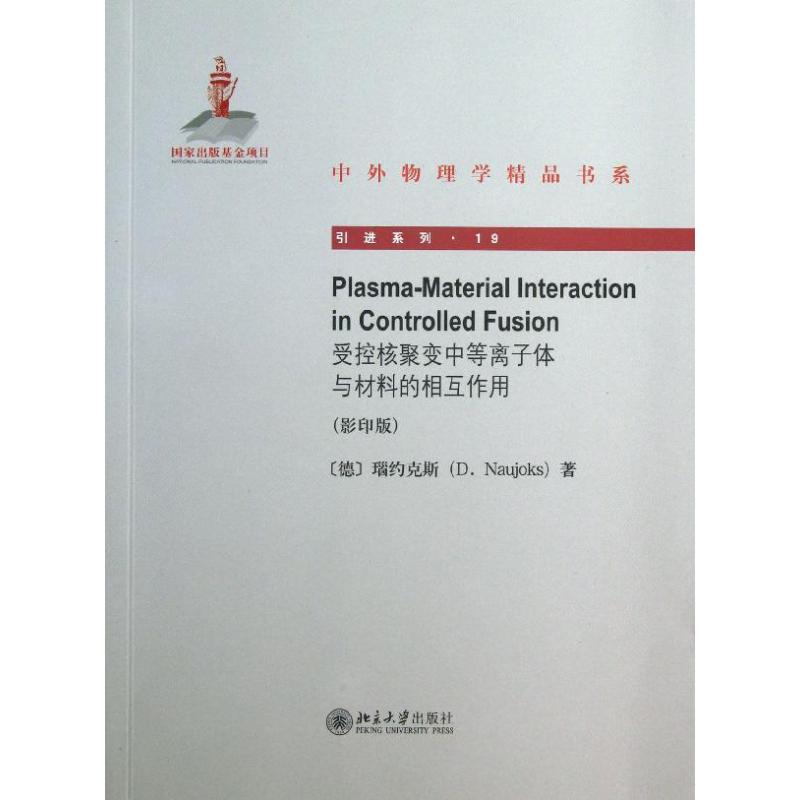
受控核聚变中的等离子体与材料的相互作用
- 书名
- 受控核聚变中的等离子体与材料的相互作用
- 作者
- (德)瑙约克斯
- 出版社
- 北京大学出版社
- 出版时间
- 2013-07-01
- ISBN
- 9787301226889
- 货号
- 1200745364
- 品相
- 全新
- 分类
- 当代·工业
- 书名
- 受控核聚变中的等离子体与材料的相互作用
- 作者
- (德)瑙约克斯
- 出版社
- 北京大学出版社
- 出版时间
- 2013-07-01
- ISBN
- 9787301226889
- 货号
- 1200745364
- 品相
- 全新
- 分类
- 当代·工业
目录▼
Introduction
Part I Fusion as Energy Source
2 Energy Problem and Related Safety Aspects
3 Fusion Fuel
3.1 Fusion Reactions
3.2 Ignition and Burn Criteria
Fusion Concepts
4.1 Inertial Plasma Confinement
4.2 Magnetic Plasma Confinement
4.3 Stellarator Concept
4.4 Tokamak Concept
4.5 Design of the First Wall
4.5.1 Limiter
4.5.2 Divertor
Part II The Plasma-Material Interface
The Plasma State
5.1 Ionization Degree and Coupling Constant.
5.2 Debye Length
5.3 Plasma Frequency
5.4 Collisions in Plasmas
5.5 Transport Processes in Plasmas
5.5.1 Transport by Binary Collisions
5.5.2 Neoclassical Diffusion
5.5.3 Anomalous Transport
5.6 The Vlasov Equation
5.7 The Poisson Equation
Particle Coupling
6.1 Binary Collisions
6.1.1 Scattering Angle
6.1.2 Scattering in the Coulomb Field, U(r) = C/r
6.1.3 Cross-Section
6.1.4 Interaction Potential U(r)
6.1.5 Binary Collision: General Case
6.2 Particle Transport in Matter
6.2.1 Definitions and Main Parameters
6.2.2 Elastic Energy Loss
6.2.3 Inelastic Energy Loss
6.3 Material Modification by Ion Beams
6.4 Retention and Tritium Inventory Control
6.5 Impurity Generation
6.5.1 Physical Sputtering
6.5.2 Chemical Erosion
6.5.3 Radiation-Enhanced Sublimation
6.5.4 Thermal Evaporation
6.5.5 Blistering
6.6 Charge Effects
6.7 Diffusion-Controlled Sputtering
6.8 Backscattering
6.8.1 One-Collision Model
6.8.2 The Diffusion Model
6.8.3 Approximations
6.9 Electron Emission
6.9.1 Secondary Electron Emission (SEE)
6.9.2 Thermionic Electron Emission
6.9.3 Electron Emission by the Application of an Electric
Field
6.10 Modeling of Particle-Solid Interaction
6.10.1 Molecular Dynamics
6.10.2 Monte Carlo Methods
Electrical Coupling
7.1 Electron Flux Density
7.2 Ion Flux Density
7.3 Bohm Criterion with the “=” Sign
7.4 Space Charge Limited Currents
7.5 Effect of Magnetic Field Geometry
7.6 Modeling of the Electric Sheath
7.6.1 Principles of PIC Simulations
7.6.2 Boundary Conditions
7.6.3 Choice of Time Step and Spatial Resolution
Power Coupling
8.1 Heat Flux Densities
8.2 Change of Surface Temperature
8.2.1 Heat Conduction in a Half-Infinite Medium.
8.2.2 Point-like Heat Load
8.2.3 Heat Conduction and Diffusion
8.3 Power Removal
8.4 Thermal Stress
Impurity Problems in Fusion Experiments
9.1 Impurity Radiation
9.1.1 Line Radiation
9.1.2 Bremsstrahlung
9.1.3 Cyclotron Radiation
9.1.4 Radiation Phenomena
9.1.5 Benefits of Radiation
9.2 Erosion Phenomena in ~sion Experiments
9.2.1 Plasma Disruption
9.2.2 Edge Localized Modes (ELMs) :
9.2.3 Runaway Electrons
9.2.4 Erosion by Energetic Alpha Particles
9.2.5 Hot Spots or Carbon “Blooming”
9.2.6 Flake and Dust Production
9.2.7 Erosion by Charge-Exchange Neutrals
9.2.8 Erosion by Arcing
9.2.9 Non-Linear Erosion due to Impurities
9.3 Impurity Transport
9.3.1 Spatial Distributions of Neutrals
9.3.2 Atomic Processes in Impure Plasmas
9.3.3 Prompt Redeposition
9.3.4 SOL Screening Efficiency
9.3.5 Accumulation of High-Z Impurities
9.3.6 Transport Barriers
9.3.7 Sawteeth as Plasma Cleaner
9.3.8 Deposition of Impurities
9.3.9 Modeling of Erosion and Redeposition
9.4 Critical Impurity Concentration
Part III Operation Limits and Criteria
10 The Problem of Plasma Density Control
10.1 Long-Term Operation
10.2 Wall Conditioning
11 Plasma Operation Limits
12 Material Operation Limits
12.1 Erosion Flux into the Plasma
12.2 Impurity Density in the Plasma Core
12.3 Impurity Criterion
12.4 Lifetime of Wall Elements
12.4.1 Simple Geometrical Model of Redeposition
12.4.2 Net Erosion at Divertor Plates
12.4.3 Net Erosion at Wall Plates
12.5 Neutron Irradiation
13 Choice of Materials
13.1 Candidates of Materials
13.1.1 Discussion of Plasma-Facing Materials
3.1.2 Construction Materials
13.2 Alternative Concepts and Innovative Ideas
13.3 Open Questions
14 Summary and Outlook
Appendix A
A.1 Some Important Relations and Parameters
A.2 Simple Particle Mover
A.3 Symbols
A.4 Abbreviations
A.5 Fundamental Physical Constants
A.6 Physical Properties of Elements
References
Index
文摘▼
本书讨论的是受控核聚变中发生的物体的四种状态之中的等离子态与固态之间的相互作用。本书在给出主要的等离子体与表面的相互作用过程的综合分析的同时,也提出了对于操作极限的判断标准和依据。通过讨论,本书将受控核聚变中可能的面向等离子体材料限制在了很小的一个范围内。本书适合核物理、材料物理等领域的研究者和研究生阅读。