 正版
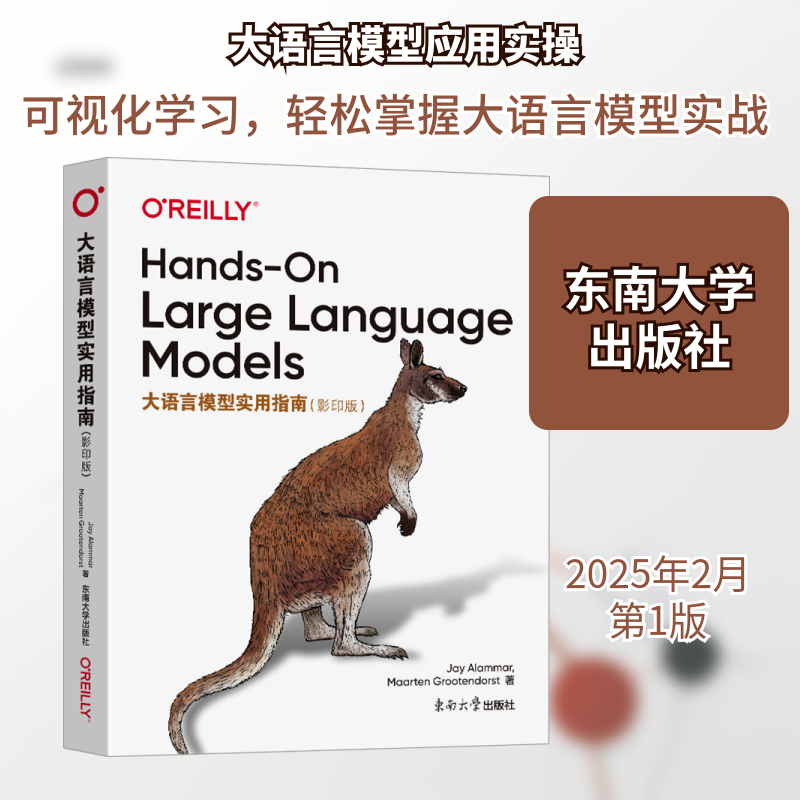
大语言模型实用指南(影印版)
- 书名
- 大语言模型实用指南(影印版)
- 作者
- (美)杰伊·阿拉玛(Jay Alammar),(美)马尔滕·葛鲁顿第斯特(Maarten Grootendorst) 著
- 出版社
- 东南大学出版社
- 出版时间
- 2025-02-01
- ISBN
- 9787576617665
- 货号
- 1203554132
- 品相
- 全新
- 分类
- 当代·工业
- 书名
- 大语言模型实用指南(影印版)
- 作者
- (美)杰伊·阿拉玛(Jay Alammar),(美)马尔滕·葛鲁顿第斯特(Maarten Grootendorst) 著
- 出版社
- 东南大学出版社
- 出版时间
- 2025-02-01
- ISBN
- 9787576617665
- 货号
- 1203554132
- 品相
- 全新
- 分类
- 当代·工业
目录▼
Preface
Part I. Understanding Language Models
1. An Introduction to Large Language Models
What Is Language AI?
A Recent History of Language AI
Representing Language as a Bag-of-Words
Better Representations with Dense Vector Embeddings
Types of Embeddings
Encoding and Decoding Context with Attention
Attention Is All You Need
Representation Models: Encoder-Only Models
Generative Models: Decoder-Only Models
The Year of Generative AI
The Moving Definition of a “Large Language Model”
The Training Paradigm of Large Language Models
Large Language Model Applications: What Makes Them So Useful?
Responsible LLM Development and Usage
Limited Resources Are All You Need
Interfacing with Large Language Models
Proprietary, Private Models
Open Models
Open Source Frameworks
Generating Your First Text
Summary
2. Tokens and Embeddings
LLM Tokenization
How Tokenizers Prepare the Inputs to the Language Model
Downloading and Running an LLM
How Does the Tokenizer Break Down Text?
Word Versus Subword Versus Character Versus Byte Tokens
Comparing Trained LLM Tokenizers
Tokenizer Properties
Token Embeddings
A Language Model Holds Embeddings for the Vocabulary of Its Tokenizer
Creating Contextualized Word Embeddings with Language Models
Text Embeddings (for Sentences and Whole Documents)
Word Embeddings Beyond LLMs
Using pretrained Word Embeddings
The Word2vec Algorithm and Contrastive Training
Embeddings for Recommendation Systems
Recommending Songs by Embeddings
Training a Song Embedding Model
Summary
3. Looking Inside Large Language Models
An Overview of Transformer Models
The Inputs and Outputs of a Trained Transformer LLM
The Components of the Forward Pass
Choosing a Single Token from the Probability Distribution (Sampling/Decoding)
Parallel Token Processing and Context Size
Speeding Up Generation by Caching Keys and Values
Inside the Transformer Block
Recent Improvements to the Transformer Architecture
More Efficient Attention
The Transformer Block
Positional Embeddings (ROPE)
Other Architectural Experiments and Improvements
Summary
Part II. Using Pretrained Language Models
4. Text Classification
The Sentiment of Movie Reviews
Text Classification with Representation Models
Model Selection
Using a Task-Specific Model
Classification Tasks That Leverage Embeddings
Supervised Classification
What If We Do Not Have Labeled Data?
Text Classification with Generative Models
Using the Text-to-Text Transfer Transformer
ChatGPT for Classification
Summary
5. Text Clustering and Topic Modeling
ArXivs Articles: Computation and Language
A Common Pipeline for Text Clustering
Embedding Documents
Reducing the Dimensionality of Embeddings
Cluster the Reduced Embeddings
Inspecting the Clusters
From Text Clustering to Topic Modeling
BERTopic: A Modular Topic Modeling Framework
Adding a Special Lego Block
The Text Generation Lego Block
Summary
6. Prompt Engineering
Using Text Generation Models
Choosing a Text Generation Model
Loading a Text Generation Model
Controlling Model Output
Intro to Prompt Engineering
The Basic Ingredients of a Prompt
Instruction-Based Prompting
Advanced Prompt Engineering
The Potential Complexity of a Prompt
In-Context Learning: Providing Examples
Chain Prompting: Breaking up the Problem
Reasoning with Generative Models
Chain-of-Thought: Think Before Answering
Self-Consistency: Sampling Outputs
Tree-of-Thought: Exploring Intermediate Steps
Output Verification
Providing Examples
Grammar: Constrained Sampling
Summary
7. Advanced Text Generation Techniques and Tools
Model I/O: Loading Quantized Models with LangChain
Chains: Extending the Capabilities of LLMs
A Single Link in the Chain: Prompt Template
A Chain with Multiple Prompts
Memory: Helping LLMs to Remember Conversations
Conversation Buffer
Windowed Conversation Buffer
Conversation Summary
Agents: Creating a System of LLMs
The Driving Power Behind Agents: Step-by-step Reasoning
ReAct in LangChain
Summary
8. Semantic Search and Retrieval-Augmented Generation
Overview of Semantic Search and RAG
Semantic Search with Language Models
Dense Retrieval
Reranking
Retrieval Evaluation Metrics
Retrieval-Augmented Generation (RAG)
From Search to RAG
Example: Grounded Generation with an LLM API
Example: RAG with Local Models
Advanced RAG Techniques
RAG Evaluation
Summary
9. Multimoflal Large Language Models
Transformers for Vision
Multimodal Embedding Models
CLIP: Connecting Text and Images
How Can CLIP Generate Multimodal Embeddings?
OpenCLIP
Making Text Generation Models Multimodal
BLIP-2: Bridging the Modality Gap
Preprocessing Multimodal Inputs
Use Case 1: Image Captioning
Use Case 2: Multimodal Chat-Based Prompting
Summary
Part III. Training and Fine-Tuning Language Models
10. Creating Text Embedding Models
Embedding Models
What Is Contrastive Learning?
SBERT
Creating an Embedding Model
Generating Contrastive Examples
Train Model
In-Depth Evaluation
Loss Functions
Fine-Tuning an Embedding Model
Supervised
Augmented SBERT
Unsupervised Learning
Transformer-Based Sequential Denoising Auto-Encoder
Using TSDAE for Domain Adaptation
Summary
11. Fine-Tuning Representation Models for Classification
Supervised Classification
Fine-Tuning a Pretrained BERT Model
Freezing Layers
Few-Shot Classification
SetFit: Efficient Fine-Tuning with Few Training Examples
Fine-Tuning for Few-Shot Classification
Continued Pretraining with Masked Language Modeling
Named-Entity Recognition
Preparing Data for Named-Entity Recognition
Fine-Tuning for Named-Entity Recognition
Summary
12. Fine-Tuning Generation Models
The Three LLM Training Steps: Pretraining, Supervised Fine-Tuning, and
Preference Tuning
Supervised Fine-Tuning (SFT)
Full Fine-Tuning
Parameter-Efficient Fine-Tuning (PEFT)
Instruction Tuning with QLoRA
Templating Instruction Data
Model Quantization
LoRA Configuration
Training Configuration
Training
Merge Weights
Evaluating Generative Models
Word-Level Metrics
Benchmarks
Leaderboards
Automated Evaluation
Human Evaluation
Preference-Tuning / Alignment / RLHF
Automating Preference Evaluation Using Reward Models
The Inputs and Outputs of a Reward Model
Training a Reward Model
Training No Reward Model
Preference Tuning with DPO
Templating Alignment Data
Model Quantization
Training Configuration
Training
Summary
Afterword
Index
文摘▼
在过去的几年,AI获得了令人惊讶的新语言能力。在深度学习快速发展的推动下,语言AI系统比以往任何时候都能更好地编写和理解文本。这一趋势正在催生新功能、新产品,甚至新的行业。通过本书的可视化教育方式,读者将学习到现在使用这些功能所需的实用工具和概念。
你将了解如何将预训练的大语言模型用于文案撰写和摘要生成等应用场景,创建超越关键字匹配的语义搜索系统,以及使用现有库和预训练的模型进行文本分类、搜索和聚类。