 正版
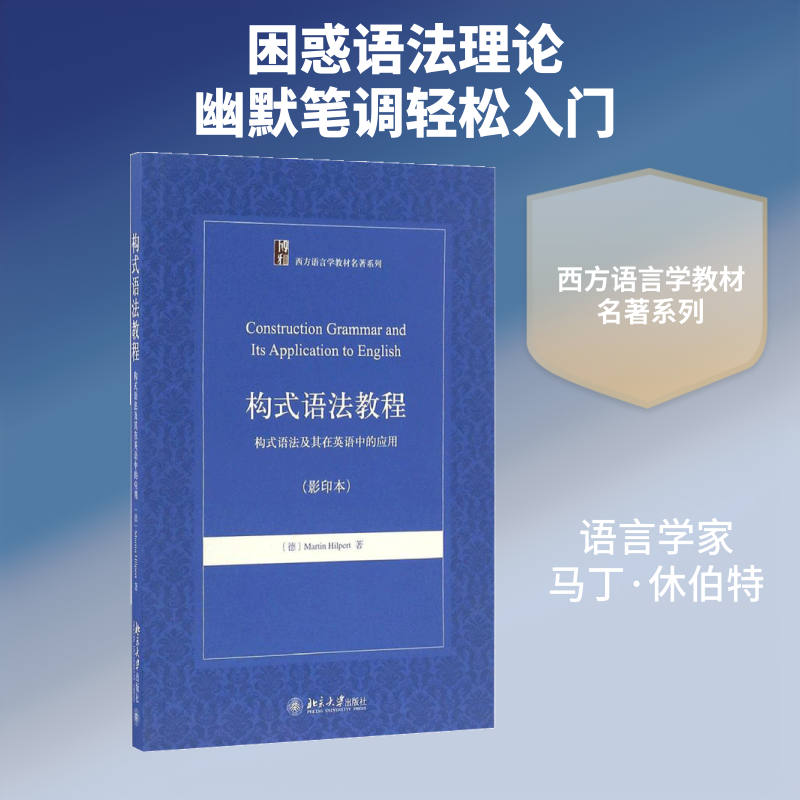
构式语法教程
- 书名
- 构式语法教程
- 作者
- (德)马丁·休伯特(Martin Hilpert) 著 著作
- 出版社
- 北京大学出版社
- 出版时间
- 2016-10-01
- ISBN
- 9787301276068
- 货号
- 1201415538
- 品相
- 全新
- 分类
- 当代·大学教材
- 书名
- 构式语法教程
- 作者
- (德)马丁·休伯特(Martin Hilpert) 著 著作
- 出版社
- 北京大学出版社
- 出版时间
- 2016-10-01
- ISBN
- 9787301276068
- 货号
- 1201415538
- 品相
- 全新
- 分类
- 当代·大学教材
目录▼
List of tables and figures ix
Acknowledgements x
To readers: Why you shouldnt pick up, let alone read, this book xi
1 Introducing Construction Grammar 1
1.1 What do you know when you know a language? 1
1.1.1 Idiomatic expressions permeate ordinary
language 3
1.1.2 Idiomatic expressions are more than fixed strings 5
1.1.3 Idiomatic expressions are productive 7
1.1.4 The growth of the appendix 7
1.2 What is a construction? 8
1.2.1 Defining constructions: a first try 9
1.2.2 Defining constructions: beyond
non-predictability 12
1.3 Identifying constructions 14
1.3.1 Does the expression deviate from canonical
patterns? 14
1.3.2 Does the expression carry non-compositional
meaning? 16
1.3.3 Does the expression have idiosyncratic
constraints? 18
1.3.4 Does the expression have collocational
preferences? 20
1.4 Summing up 22
1.5 Outline of the following chapters 23
Study questions 23
Further reading 24
2 Argument structure constructions 25
2.1 Analysing ‘simple sentences’ 25
2.2 Argument structure 26
2.3 Valency-increasing constructions 31
2.3.1 The DITRANSITIVE construction 31
2.3.2 The CAUSED MOTION construction 35
2.3.3 The WAY construction 36
2.4 Valency-decreasing constructions 39
2.4.1 The PASSIVE 39
2.4.2 The IMPERATIVE construction 42
2.4.3 NULL INSTANTIATION 44
2.5 Relations between argument structure constructions 45
2.6 Summing up 47
Study questions 49
Further reading 49
3 Inside the construct-i-con 50
3.1 Meaningless constructions? 50
3.2 The construct-i-con: a network of interlinked
constructions 57
3.2.1 Inheritance 57
3.2.2 Kinds of inheritance links 60
3.2.3 Complete inheritance vs. redundant
representations 65
3.3 ‘Normal syntax’ in Construction Grammar 67
3.4 Summing up 71
Study questions 72
Further reading 73
4 Constructional morphology 74
4.1 More than a theory of syntax 74
4.1.1 one wug, two wugs 74
4.1.2 skypable 75
4.1.3 shpants 77
4.1.4 a what-the-heck-is-wrong-with-you look 79
4.2 Morphological constructions and their properties 80
4.2.1 Morphological productivity 81
4.2.2 Paradigmatic organisation 83
4.2.3 Non-compositional meanings 85
4.2.4 Simultaneous affixation 86
4.3 Constructional solutions to morphological puzzles 88
4.3.1 Affix ordering 88
4.3.2 Compounding 93
4.4 Summing up 97
Study questions 99
Further reading 100
5 Information packaging constructions 101
5.1 The pragmatic side of Construction Grammar 101
5.1.1 Information packaging: the basics 104
5.1.2 Presupposition and assertion 105
5.1.3 Activation 107
5.1.4 Topic and focus 109
5.2 Information packaging and grammar 111
5.2.1 Cleft constructions 112
5.2.2 Dislocation and related constructions 117
5.3 Island constraints 123
5.4 Summing up 126
Study questions 128
Further reading 128
6 Constructions and language processing 130
6.1 The quest for behavioural evidence 130
6.2 Evidence from language comprehension 132
6.2.1 Constructions explain how hearers understand
novel denominal verbs 132
6.2.2 Constructional meanings are routinely accessed
in sentence comprehension 134
6.2.3 Constructions explain knowledge of grammatical
unacceptability 137
6.2.4 Constructions explain incidental verbatim
memory 142
6.3 Evidence from language production 144
6.3.1 Constructions explain reduction effects in
speech 144
6.3.2 Constructions explain syntactic priming, and
exceptions to syntactic priming 145
6.3.3 Constructions explain how speakers complete
sentences 148
6.4 Summing up 151
Study questions 154
Further reading 154
7 Constructions and language acquisition 155
7.1 Construction Grammar for kids 155
7.1.1 Item-based learning 156
7.1.2 The sociocognitive foundation of language
learning 158
7.2 Evidence for the item-based nature of language learning 163
7.3 From item-based schemas to constructions 169
7.4 The acquisition of complex sentences 172
7.5 Summing up 176
Study questions 178
Further reading 178
8 Language variation and change 179
8.1 Language myths 179
8.2 Constructional variation 181
8.2.1 Theres more than one way to do it 181
8.2.2 Variation in syntactic constructions: the example
of relative clauses 183
8.2.3 Analysing variation between constructions 185
8.3 Constructional variation across groups of speakers 191
8.4 Constructional change: variation across time 194
8.5 Summing up 199
Study questions 200
Further reading 201
9 Concluding remarks 202
References 205
Index 217
文摘▼
本书是语言学家马丁·希伯特为英语专业大学生编写的一本介绍构式语法理论的入门教材,以英语为例,讲授构式语法的基本概念,论元结构构式,构式库的基本结构,构式语法在形态学、语用、语言习得、语言处理等方面的应用等内容。由于教学对象是大学新生,作者的写作笔调轻松诙谐,引人入胜,是一本很好的构式语法教材。