 正版
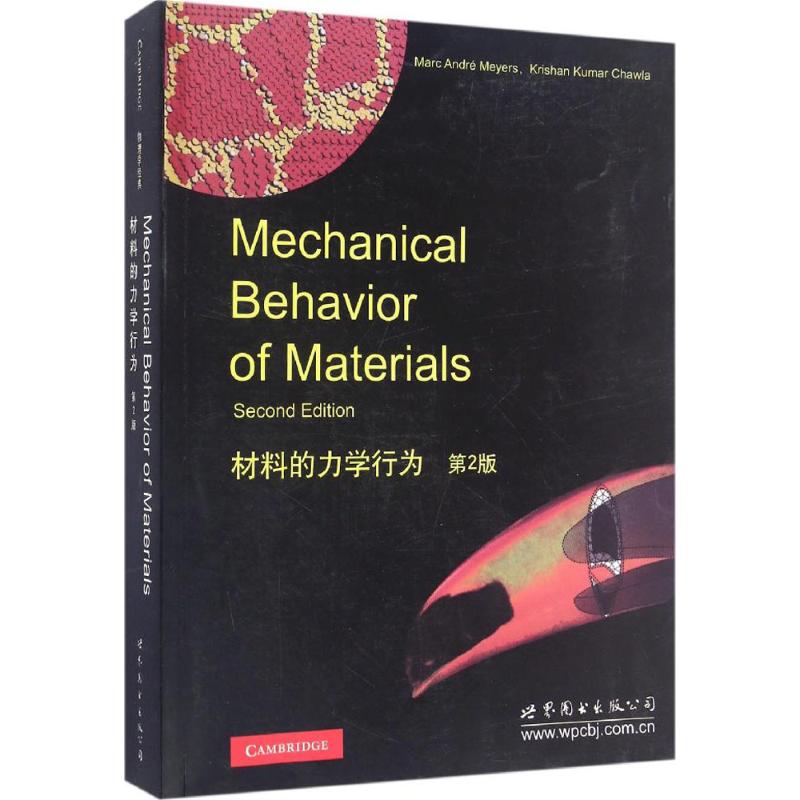
材料的力学行为
- 书名
- 材料的力学行为
- 作者
- (美)M.A.迈耶斯(Mare Andre Meyers),(美)K.K.舒拉(Krishan Kumar Chawla) 著
- 出版社
- 世界图书出版有限公司北京分公司
- 出版时间
- 2016-05-01
- ISBN
- 9787519213442
- 货号
- 1201454124
- 品相
- 全新
- 分类
- 当代·科技
- 书名
- 材料的力学行为
- 作者
- (美)M.A.迈耶斯(Mare Andre Meyers),(美)K.K.舒拉(Krishan Kumar Chawla) 著
- 出版社
- 世界图书出版有限公司北京分公司
- 出版时间
- 2016-05-01
- ISBN
- 9787519213442
- 货号
- 1201454124
- 品相
- 全新
- 分类
- 当代·科技
作者简介▼
Marc Andre Meyers,Krishan Kumar Chawla是物理领域知名专家,他们合著的《材料的力学行为》是一部经典著作。
目录▼
Preface to the First Edition
Preface to the Second Edition
A Note to the Reader
Chapter 1 Materials: Structure,Properties,and Performance
1.1 Introduction
1.2 Monolithic,Composite,and Hierarchical Materials
1.3 Structure of Materials
1.3.1 Crystal Structures
1.3.2 Metals
1.3.3 Ceramics
1.3.4 Glasses
1.3.5 Polymers
1.3.6 Liquid Crystals
1.3.7 Biological Materials and Biomaterials
1.3.8 Porous and Cellular Materials
1.3.9 Nano and Microstructure ofBiological Materials
1.3.10 The Sponge Spicule: An Example ofa Biological Material
1.3.11 Active(or Smart)Materials
1.3.12 Electronic Materials
1.3.13 Nanotechnology
1.4 Strength ofReal Materials
Suggested Reading
Exercises
Chapter 2 Elasticity and Viscoelasticity
2.1 Introduction
2.2 Longitudinal Stress and Strain
2.3 Strain Energy(or Deformation Energy)Density
2.4 Shear Stress and Strain
2.5 Poissons Ratio
2.6 More Complex States ofStress
2.7 Graphical Solution of a Biaxial State of Stress: the Mohr Circle
2.8 Pure Shear: Relationship between G and E
2.9 AnisotropicEffects
2.10 Elastic Properties ofPolycrystals
2.11 Elastic Properties ofMaterials
2.11.1 Elastic Properties ofMetals
2.11.2 Elastic Properties ofCeramics
2.11.3 Elastic Properties ofPolymers
2.11.4 Elastic Constants of Unidirectional Fiber Reinforced Composite
2.12 Viscoelasticity
2.12.1 Storage and Loss Moduli
2.13 Rubber Elasticity
2.14 Mooney—Rivlin Equation
2.15 Elastic Properties of Biological Materials
2.15.1 Blood Vessels
2.15.2 Articular Cartilage
2.15.3 Mechanical Properties at the Nanometer Level
2.16 Elastic Properties of Electronic Materials
2.17 Elastic Constants and Bonding
Suggested Reading
Exercises
Chapter 3 Plasticity
3.1 Introduction
3.2 Plastic Deformation in Tension
3.2.1 Tensile Curve Parameters
3.2.2 Necking
3.2.3 Strain Rate Effects
3.3 Plastic Deformation in Compression Testing
3.4 The Bauschunger Effect
3.5 Plastic Deformation of Polymers
3.5.1 Stress—Strain Curves
3.5.2 Classy Polymers
3.5.3 Semicrystalline Polymers
3.5.4 Viscous Flow
3.5.5 Adiabatic Heating
3.6 Plastic Deformation of Glasses
3.6.1 Microscopic Deformation Mechanism
3.6.2 Temperature Dependence and Viscosity
3.7 Flow,Yield,and Failure Criteria
3.7,1 Maximum—Stress Criterion(Rankine)
3.7.2 Maximum—Shear—Stress Criterion(Tresca)
3.7.3 Maximum—Distortion—Energy Criterion(von Mises)
3.7.4 Graphical Representation and Experimental Verification of Rankine,Tresca.and von Mises Criteria
3.7.5 Failure Criteria for Brittle Materials
3.7.6 Yield Criteria for Ductile Polymers
3.7.7 Failure Criteria for Composite Materials
3.7.8 Yield and Failure Criteria for Other Anisotropic
Materials
3.8 Hardness
3.8.1 Macroindentation Tests
3.8.2 Microindentation Tests
3.8.3 Nanoindentation
3.9 Formability: Important Parameters
3.9.1 Plastic Anisotropy
3.9.2 Punch—Stretch Tests and Forming—Limit Curves(or Keeler—Goodwin Diagrams)
3.10 Muscle Force
3.11 Mechanical Properties of Some Biological Materials Suggested Reading
Exercises
Chapter 4 Imperfections: Point and Line Defects
4.1 Introduction
4.2 Theoretical Shear Strength
4.3 Atomic or Electronic Point Defects
4.3.1 Equilibrium Concentration of Point Defects
4.3.2 Production of Point Defects
4.3.3 Effect of Point Defects on Mechanical
Properties
4.3.4 Radiation Damage
4.3.5 Ion Implantation
4.4 Line Defects
4.4.1 Experimental Observation of Dislocations
4.4.2 Behavior of Dislocations
4.4.3 Stress Field Around Dislocations
4.4.4 Energy of Dislocations
4.4.5 Force Required to Bow a Dislocation
4.4.6 Dislocations in Various Structures
4.4.7 Dislocations in Ceramics
4.4.8 Sources of Dislocations
4.4.9 Dislocation Pileups
4.4.10 Intersection of Dislocations
4.4.11 Deformation Produced by Motion of Dislocations(Orowans Equation)
4.4.12 The Peierls—Nabarro Stress
4.4.13 The Movement of Dislocations: Temperature and Strain Rate Effects
4.4.14 Dislocations in Electronic Materials
Suggested Reading
Exercises
Chapter 5 Imperfections: Interfacial and Volumetric Defects
5.1 Introduction
5.2 Grain Boundaries
5.2.1 Tilt and Twist Boundaries
5.2.2 Energy of a Grain Boundary
5.2.3 Variation of Grain—Boundary Energy with
Misorientation
5.2.4 Coincidence Site Lattice {CSL)Boundaries
5.2.5 Grain Boundary Triple Junctions
5.2.6 Grain—Boundary Dislocations and Ledges
5.2.7 Grain Boundaries as a Packing of Polyhedral Units
5.3 Twinning and Twin Boundaries
5.3.1 Crystallography and Morphology
5.3.2 Mechanical Effects
5.4 Grain Boundaries in Plastic Deformation(Grain—size Strengthening)
5.4.1 Hall—Petch Theory
5.4.2 Cottrells Theory
5.4.3 Lis Theory
5.4.4 Meyers—AshworthTheory
5.5 Other Internal Obstacles
5.6 NanocrystallineMaterials
5.7 Volumetric or Tridimensional Defects
5.8 Imperfections in Polymers
Suggested Reading
Exerases
Chapter 6 Geometry of Deformation and Work—Hardening
6.1 Introduction
6.2 Geometry of Deformation
6.2.1 Stereographic Projections
6.2.2 Stress Required for Slip
6.2.3 Shear Deformation
6.2.4 Slip in Systems and Work—Hardening
6.2.5 Independent Slip Systems in Polycrystals
6.3 Work—Hardening in Polycrystals
6.3.1 Taylors Theory
6.3.2 Seegers Theory
6.3.3 Kuhlmann—Wilsdorrs Theory
6.4 Softening Mechanisms
6.5 Texture Strengthening
Suggested Reading
Exercises
Chapter 7 Fracture: Macroscopic Aspects
7.1 Introduction
7.2 Theorectical Tensile Strength
7.3 Stress Concentration and Griffith Criterion of Fracture
7.3.1 Stress Concentrations
7.3.2 Stress Concentration Factor
7.4 Griffith Criterion
7.5 Crack Propagation with Plasticity
7.6 Linear Elastic Fracture Mechanics
7.6.1 Fracture Toughness
7.6.2 Hypotheses of LEFM
7.6.3 Crack—Tip Separation Modes
7.6.4 Stress Field in an Isotropic Material in the Viciruty of a Crack Tip
7.6.5 Details of the Crack—Tip Stress Field in Mode I
7.6.6 Plastic—Zone Size Correction
7.6.7 Variation in Fracture Toughness with Thickness
7.7 Fracture Toughness Parameters
7.7.1 Crack Extension Force G
7.7.2 Crack Opening Displacement
7.7.3 J Integral
7.7.4 R Curve
7.7.5 Relationships among Different Fracture Toughness Parameters
7.8 Importance of Kic in Practice
7.9 Post—Yield Fracture Mechanics
7.10 StatisticaIAnalysis ofFailure Strength
Appendix: Stress Singularity at Crack Tip
Suggested Reading
Exerases
Chapter 8 Fracture: Microscopic Aspects
8.1 Introduction
8.2 Fracture in Metals
8.2.1 Crack Nucleation
8.2.2 Ductile Fracture
8.2.3 Brittle,or Cleavage,Fracture
8.3 Fracture in Ceramics
8.3.1 MicrostructuralAspects
8.3.2 Effect of Grain Size on Strength of Ceramics
8.3.3 Fracture of Ceramics in Tension
8.3.4 Fracture in Ceramics Under Compression
8.3.5 Thermallylnduced Fracture in Ceramics
8.4 Fracturein Polymers
8.4.1 Brittle Fracture
8.4.2 Crazing and Shear Yielding
8.4.3 Fracture in Semicrystalline and Crystalline Polymers
8.4.4 Toughness of Polymers
8.5 Fracture and Toughness of Biological Materials
8.6 Fracture Mechanism Maps
Suggested Reading
Exercises
Chapter 9 Fracture Testing
9.1 Introduction
9.2 ImpactTesting
9.2.1 Charpy Impact Test
……
Chapter 10 Solid Solution,Precipitation,and Dispersion Strengthening
Chapter 11 Martensitic Transformation
Chapter 12 Special Materials: Intermetallics and Foams
Chapter 13 Creep and Superplasticity
Chapter 14 Fatigue
Chapter 15 Composite Materials
Chapter 16 Environmental Effects
文摘▼
《材料的力学行为》是目前最流行的材料力学行为研究生或者高年级本科生教材,囊括了生物材料和电子材料的最新进展,并且做到了巧妙的平衡。为了确保能够透彻全面地学习理解大量材料的微观和纳米级的基础原理,书中尽量要求数学简单,避免涉猎大量有关材料的延伸知识。这样完整地讲清楚了材料微观结构是如何控制力学行为,大量微观图和案例的应用,更加加强了这一感觉。新增加的例子和练习能够帮助更好地学习本书。