 正版
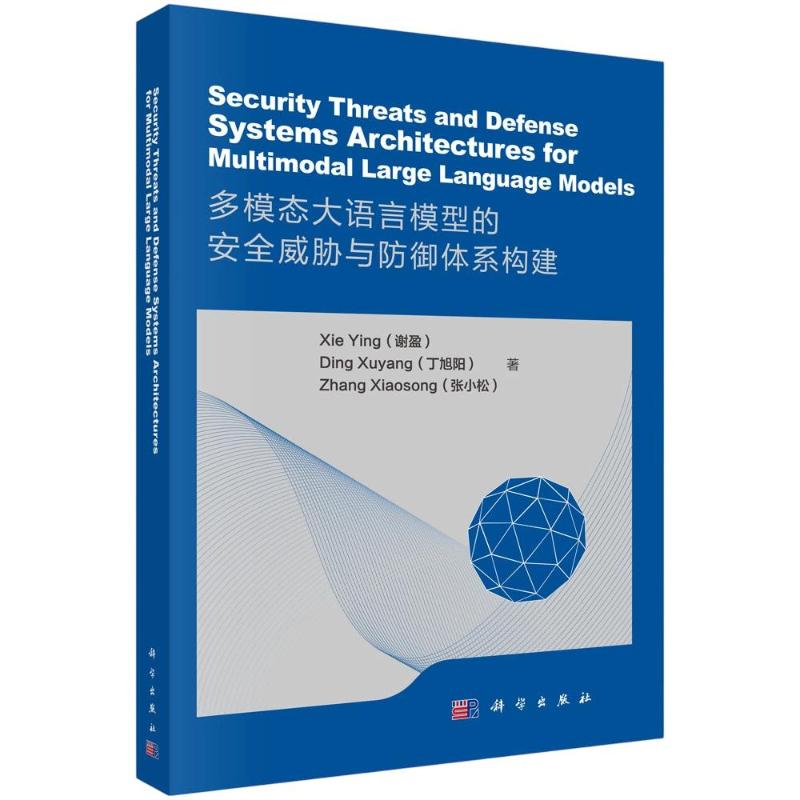
SECURITY THREATS AND DEFENSE SYSTEMS ARCHITECTURES FOR MULTIMODAL LARGE LANGUAGE MODEL
- 书名
- SECURITY THREATS AND DEFENSE SYSTEMS ARCHITECTURES FOR MULTIMODAL LARGE LANGUAGE MODEL
- 作者
- 谢盈,丁旭阳,张小松 著
- 出版社
- 科学出版社
- 出版时间
- 2026-06-01
- ISBN
- 9787030848901
- 货号
- 1204451050
- 品相
- 全新
- 分类
- 当代·工业
- 书名
- SECURITY THREATS AND DEFENSE SYSTEMS ARCHITECTURES FOR MULTIMODAL LARGE LANGUAGE MODEL
- 作者
- 谢盈,丁旭阳,张小松 著
- 出版社
- 科学出版社
- 出版时间
- 2026-06-01
- ISBN
- 9787030848901
- 货号
- 1204451050
- 品相
- 全新
- 分类
- 当代·工业
作者简介▼
2020中国交通运输协会科学技术奖,排名2
目录▼
Part I MLLMs: Technology and Security Overview
Chapter 1 Introduction to MLLMs: Technology and Security
1.1 Overview of MLLM Technology
1.1.1 From Unimodal LLMs to MLLMs: Capability and Architecture Shifts
1.1.2 Comparative Analysis of Mainstream Multimodal Model Structures
1.1.3 Typical Application Scenarios of Multimodal Models
1.2 Overview of the Life Cycle and Attack Surface of MLLMs
1.2.1 Overview of the Life Cycle of MLLMs
1.2.2 Distribution of Potential Security Risks at Each Stage of the Model
1.2.3 Analysis of New Risk Types Specific to Multimodality
1.3 Chapter Summary
References
Part II Overview of Threat Models and Attack Techniques for Multimodal Models
Chapter 2 Overview of Threat Models and Attack Techniques for Multimodal Models
2.1 Data and Training Phase Attack Techniques
2.1.1 Modality-Aware Data Poisoning Attacks
2.1.2 Cross-Modal Backdoor Attack Mechanism
2.1.3 Model Inversion and Membership Inference Attacks
2.1.4 Modality Imbalance Attacks
2.2 Attack Techniques in the Reasoning and Fusion Phase
2.2.1 Image-Text Joint Adversarial Sample Attacks
2.2.2 Cross-Modal Hallucination Attacks
2.2.3 Modal Injection Attacks
2.3 Risks of Abuse and External Attacks
2.3.1 Risks of Abuse
2.3.2 External Attacks
2.4 Chapter Summary
References
Part III Overview of Defense Strategies for MLLMs
Chapter 3 Introduction to MLLMs Defense Strategies
3.1 Multimodal Adversarial Defense Strategies
3.1.1 Multimodal Adversarial Training Strategy
……
文摘▼
Against the backdrop of the technological development of multimodal models, this book first introduces its core architecture and typical application scenarios, building upon this foundation to construct a security threat analysis framework covering the entire life cycle. It then delves into typical attack methods faced during the training and inference phases, such as data poisoning, backdoor attacks, cross-modal adversarial examples, and prompt injection, further proposing systematic defense strategies and engineering implementation methods covering all stages of model training, inference, and deployment. Finally, in conjunction with cutting-edge technological developments, it provides an outlook on the future trends and challenges of multimodal model security.
This book has a broad readership, suitable for researchers engaged in large-scale model and artificial intelligence security research, as well as engineering and technical personnel involved in the development, deployment, and operation of multimodal intelligent systems. It is also suitable for readers interested in large-scale model security, trustworthy artificial intelligence, and governance issues, providing them with a systematic knowledge framework and practical reference.