 正版
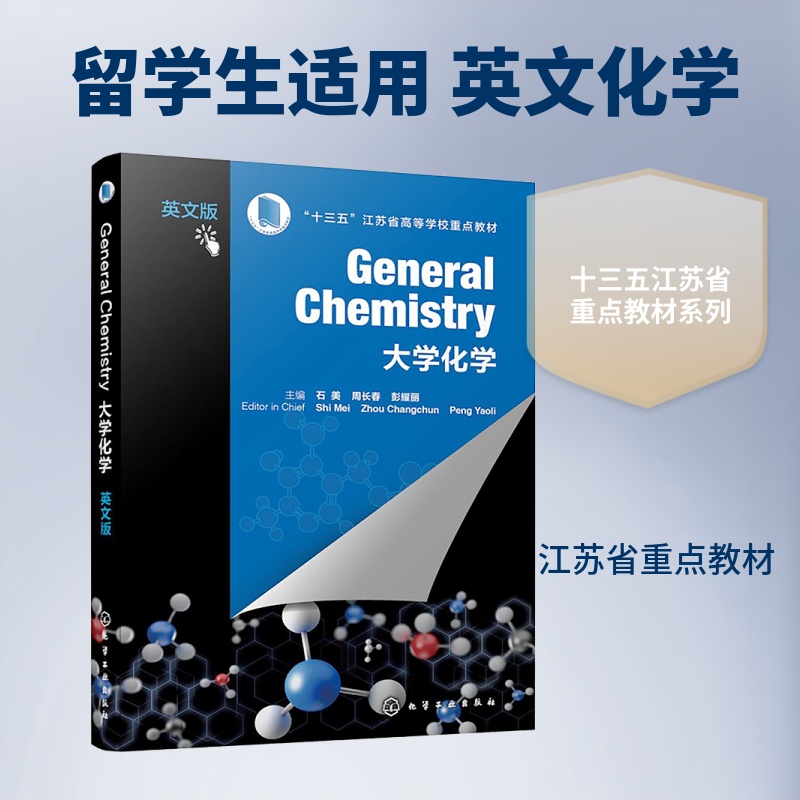
GENERAL CHEMISTRY(大学化学 英文版)(石美)
- 书名
- GENERAL CHEMISTRY(大学化学 英文版)(石美)
- 作者
- 石美,周长春,彭耀丽 主编
- 出版社
- 化学工业出版社
- 出版时间
- 2026-08-01
- ISBN
- 9787122505729
- 货号
- 1204473937
- 品相
- 全新
- 分类
- 当代·科技
- 书名
- GENERAL CHEMISTRY(大学化学 英文版)(石美)
- 作者
- 石美,周长春,彭耀丽 主编
- 出版社
- 化学工业出版社
- 出版时间
- 2026-08-01
- ISBN
- 9787122505729
- 货号
- 1204473937
- 品相
- 全新
- 分类
- 当代·科技
目录▼
Chapter 1 Introduction/001
1.1 Scientific research method 002
1.2 Why should we study chemistry? 004
1.3 Classification of matter 005
1.4 Properties of matter 011
1.5 Measurement of matter 012
1.6 Uncertainties of measurement 015
Exercises 018
Quick quiz 020
Chapter 2 Gases and Liquids/022
2.1 The gas laws 023
2.2 The ideal gas equation 025
2.3 Mixture of gases 027
2.4 Real gases 029
2.5 Liquid 031
2.6 Concentration of solutions 034
2.7 Colligative properties 036
Exercises 043
Quick quiz 045
Chapter 3 Thermodynamics/047
3.1 Basic terminology of thermodynamics 048
3.2 Enthalpy 057
3.3 Entropy 067
3.4 Gibbs free energy 072
3.5 Chemical equilibrium 075
3.6 Factors affect equilibrium 083
Exercises 088
Quick quiz 094
Chapter 4 Chemical Kinetics/098
4.1 Reaction rate 099
4.2 Rate law 102
4.3 Simple order of reaction 103
4.4 Theoretical models for chemical kinetics 107
4.5 Reaction mechanisms 112
Exercises 116
Quick quiz 119
Chapter 5 Acid-Base Equilibria/122
5.1 Types of acids and bases 123
5.2 pH scales 127
5.3 Equilibria of weak acid and weak base solutions 131
5.4 Buffer solution 135
5.5 Titration curves 138
Exercises 141
Quick quiz 145
Chapter 6 Solubility and Complex-Ion Equilibria/148
6.1 Complex-ion and their nomenclature 149
6.2 Equilibrium formation constants for complex compounds 154
6.3 Properties of complex compounds 156
6.4 Solubility product constant 160
6.5 Solubility and Ksp 163
6.6 Factors that affect solubility 165
6.7 Precipitation of ionic compounds 171
6.8 Selective precipitation of ions 172
Exercises 173
Quick quiz 176
Chapter 7 Electrochemistry/179
7.1 Basic concepts of electrochemistry 180
7.2 Cell potentials and Gibbs free energy changes for cell reaction 187
7.3 Cell potentials under nonstandard conditions 196
7.4 Batteries and fuel cells 203
7.5 Corrosion 208
7.6 Electrolysis 211
Exercises 213
Quick quiz 216
Chapter 8 Structural Chemistry/219
8.1 Atomic structure 220
8.2 The nature of radiant energy 228
8.3 The foundation of quantum mechanics 230
8.4 Orbitals and four quantum numbers 240
8.5 Representations of orbitals 244
8.6 Electron configuration 248
8.7 The periodic table and the principles 253
8.8 Chemical bonding 261
8.9 Molecular geometry and bond theories 269
8.10 Intermolecular forces 278
8.11 Crystals and their structure 283
Exercises 288
Quick quiz 292
Reference/296
Appendices/297
Appendix A Prefixes used in the metric system and with SI units 297
Appendix B van der Waals constants and compressibility factors (at 10 bar and 300 K) for various gases 297
Appendix C Thermodynamic quantities at 25 ℃ 298
Appendix D Equilibrium constants at 25 ℃ 302
Appendix E Standard reduction potential at 25 ℃ 306
Appendix F Physical constants, conversion factors, and geometric formulas 307
Answer to Exercises and Quick Quizzes/311
文摘▼
After a thorough review of existing undergraduate General Chemistry textbooks in English, we found that, although many such books are available, few are truly suitable for Chinese and international students pursuing a bachelor's degree in China. An appropriate textbook must align with the requirements of the Chinese higher education system by combining rigorous content, pedagogical innovation, and accessible digital resources, this textbook aims to meet the specific needs of students in China while also supporting the broader goals of globalized, sustainable chemistry education.
The authors have been teaching General Chemistry for decades, giving us deep insight into the difficulties, challenges, and opportunities that both instructors and learners encounter. Accordingly, each chapter of this book is enriched with carefully designed examples, exercises, and quick quizzes that address these issues directly. To integrate modern instructional tools with the textbook, we have adopted a stacked learning architecture that guides students from macroscopic to microscopic perspectives. Chapters 1-6 develop a logical, macroscopic chemical framework, covering thermodynamics and its applications in chemical equilibrium, acid-base equilibria, solubility-product equilibria, and electrochemistry. Chapter 7 introduces quantum chemistry, fostering a fundamentally different way of thinking and expanding students' horizons by revealing the distinct behavior of particles at the atomic and molecular levels. An online component is seamlessly linked to the printed material. At the beginning of each chapter, a QR code directs students to the corresponding digital resources, enabling self-study even in the absence of an instructor.
In addition, the textbook is designed to help teachers cultivate students' ability to construct an integrated General Chemistry knowledge system and self-regulated learning. We have woven a broad spectrum of chemical discoveries into the narrative—including topics that are often overviewed in everyday life, societal challenges such as renewable energy, sustainable development, and human health, as well as the contributions of seminal figures whose research profoundly shaped the present whole system of chemistry.