 正版
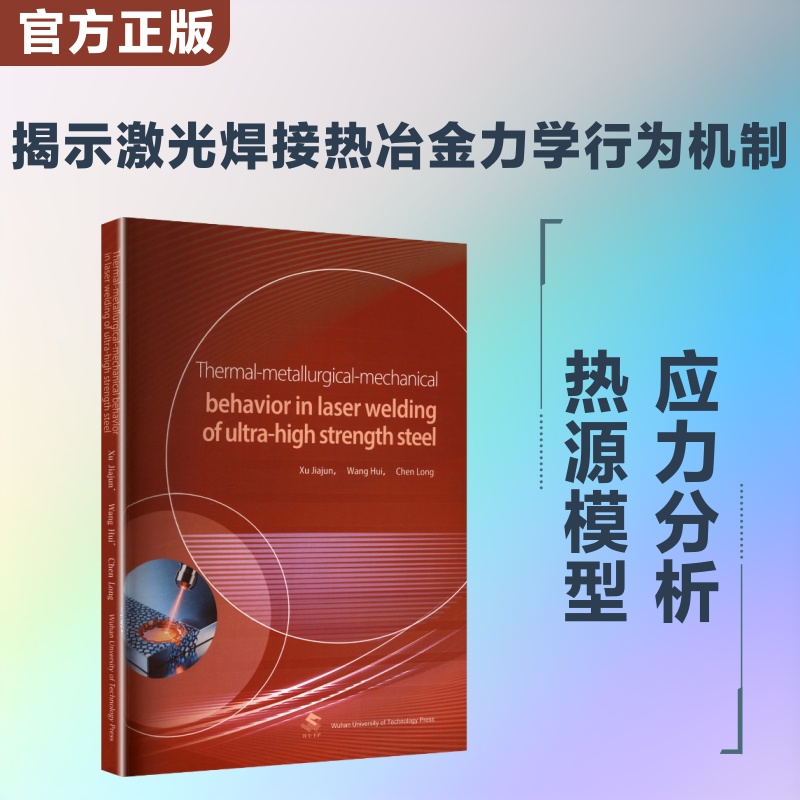
超高强度钢激光焊接的热冶金力学行为
- 书名
- 超高强度钢激光焊接的热冶金力学行为
- 作者
- 徐加俊,王辉,陈龙 著
- 出版社
- 武汉理工大学出版社
- 出版时间
- 2026-04-01
- ISBN
- 9787562975946
- 货号
- 1204688434
- 品相
- 全新
- 分类
- 当代·工业
- 书名
- 超高强度钢激光焊接的热冶金力学行为
- 作者
- 徐加俊,王辉,陈龙 著
- 出版社
- 武汉理工大学出版社
- 出版时间
- 2026-04-01
- ISBN
- 9787562975946
- 货号
- 1204688434
- 品相
- 全新
- 分类
- 当代·工业
目录▼
1 The development for thermal-metallurgical-mechanical coupled simulation in laser welding of ultra-high strength steel
1.1 Introduction
1.2 Laser welding process of advanced high strength steel
1.2.1 Laser welding process of DP Steel
1.2.2 TRIP steel laser welding process
1.2.3 MS laser welding process
1.3 Thermal-metallurgical-mechanical coupled simulation of laser welding
1.3.1 Welding heat source model
1.3.2 Flow stress model
1.3.3 Thermal-metallurgical-mechanical coupling model
References
2 Visualization and simulation of laser welding based on three-dimensional geometries of weld pool and keyhole
2.1 Introduction
2.2 Materials and methods
2.3 Three-dimensional characterization of weld pool and keyhole
2.3.1 Image processing
2.3.2 Effects of welding speed on geometries of keyhole and weld pool
2.4 Thermal analysis
2.4.1 Heat source model
2.4.2 Thermal analysis implementation
2.4.3 Heat source model validation
2.5 Conclusions
References
3 Forming mechanism of weld cross section and a novel validation method
3.1 Introduction
3.2 Experiment details and numerical modeling
3.2.1 Experiment details
3.2.2 Governing equations and boundary conditions
3.2.3 Heat source model
3.3 Results and discussion
3.3.1 Change rule of upper/bottom/waist widths with time
3.3.2 Formation mechanism of WCS
3.3.3 Comparation of the validation results based on the transient and max-temperature WCSs
3.4 Conclusions
References
4 Effects of SSPT-induced changes in thermal properties on the evolutions of temperature and phase fraction
4.1 Introduction
4.2 Experiment and thermal analysis details
4.3 Solid-state phase transformation model
4.3.1 SSPT model of martensite-austenite
4.3.2 SSPT model of Austenite-martensite
4.4 Thermal-metallurgical analysis and computation implementation
4.4.1 Effect of the SSTP on thermal properties
4.4.2 Computation implementation
4.5 Results and discussion
4.5.1 Phase fraction distribution
4.5.2 Evolutions of temperature and phase fraction
4.6 Conclusions
References
5 Improving the prediction accuracy of thermal analysis through an automated optimization method
5.1 Introduction
5.2 Methodology
5.2.1 Optimization methodology
5.2.2 Thermal FE analysis
5.2.3 Model simplification
5.2.4 Case details and optimization program setup
5.3 Results and discussion
5.3.1 Effect of model geometry on the solution
5.3.2 Effect of latent heat on the solution
5.3.3 Optimization result analysis
5.4 Conclusions
References
6 Stress evolution mechanism considering the effects of temperature sensitivity, strain hardening and annealing
6.1 Introduction
6.2 Experiment Details
6.3 Numerical model and computation implementation
6.3.1 Thermo-elastic-plastic constitutive relationship
6.3.2 Stress updating algorithm
6.3.3 Flow stress model
6.3.4 Computation implementation
6.4 Results and discussion
6.4.1 Validation of USERMAT subroutine
6.4.2 Validation of prediction residual stress results
6.4.3 Effects of temperature sensitivity,strain hardening and annealing on stress
6.4.4 Stress evolution mechanism
6.5 Conclusions
References
7 Stress evolution mechanisms under different SSPT-related effects
7.1 Introduction
7.2 Experiment and thermal analysis details
7.3 Solid-state phase transformation model
7.3.1 Heating rate-dependent martensite-austenite transformation model
7.3.2 Austenite-martensite transformation model
7.4 Mechanical-metallurgical analysis and computation implementation
7.4.1 Effect of the SSTP on yield strength
7.4.2 Effect of the SSTP on strain
7.4.3 Computation implementation
7.5 Results and discussion
7.5.1 Validation of the proposed austenization model
7.5.2 Effect of SSPT on residual stress
7.5.3 Stress evolution mechanism
7.6 Conclusions
References
文摘▼
本书聚焦于先进高强度钢(AHSS)在汽车轻量化中的焊接难题,揭示了激光焊接中高温梯度、固态相变(SSPT)及残余应力对焊缝性能的影响机制。核心内容包括:建立考虑小孔几何与能量分布的双圆柱热源模型,结合高速成像技术分析熔池与小孔动态行为;开发基于粒子群算法的热源参数自动优化技术,提升模型预测能力等。